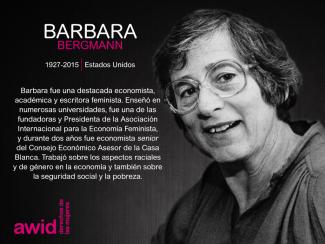
AWID es un organización feminista internacional de membresía, que brinda apoyo a los movimientos que trabajan para lograr la justicia de género y los derechos de las mujeres en todo el mundo.
Una organización creativa, frente a una creciente amenaza
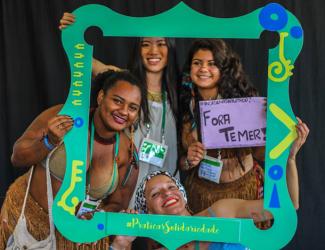
El activismo joven feminista juega un papel fundamental en las organizaciones y los movimientos por los derechos de las mujeres a nivel mundial, ya que aborda los nuevos problemas a los que las feministas se enfrentan en la actualidad. Esta fuerza, creatividad y adaptabilidad son esenciales para la sostenibilidad de la organización feminista.
A la vez, enfrentan obstáculos específicos para ejercer su activismo, como acceso limitado al financiamiento y al apoyo, falta de oportunidades de capacitación, un incremento considerable de los ataques contra las jóvenes defensoras de los derechos humanos. Esto crea una falta de visibilidad que hace más complicada su inclusión y participación efectiva en los movimientos por los derechos de las mujeres.
Un enfoque multigeneracional
El programa de activismo joven feminista fue creado para garantizar que las voces de las jóvenes sean escuchadas y se vean reflejadas en el discurso feminista. Queremos garantizar que las jóvenes feministas tengan un mejor acceso al financiamiento, a las oportunidades de desarrollo de las capacidades y a los procesos internacionales.
Además de apoyar directamente a las jóvenes feministas, estamos trabajando con activistas por los derechos de las mujeres de todas las edades, con modelos y estrategias prácticas para procesos efectivos de organización intergeneracionales.
Nuestras acciones
Queremos que las activistas jóvenes feministas jueguen un papel en el proceso de toma de decisiones que afectan sus derechos a través de:
Fomento de la comunidad e intercambio de información a través de la Conexión Joven Feminista. Dada la importancia de los medios virtuales para el trabajo de las jóvenes feministas, nuestro equipo lanzó la Conexión Joven Feminista en mayo de 2010 para compartir información, construir capacidades a través de seminarios web y discusiones electrónicas y para alentar la construcción de la comunidad.
Investigación y generación de conocimientos sobre el activismo joven feminista, que aumenten la visibilidad y el impacto del activismo joven feminista en los movimientos por los derechos de las mujeres y otros actores clave, como los donantes.
Promoción de procesos más efectivos de organización intergeneracional, explorando mejores formas de trabajar en conjunto.
Apoyo a la participación de las jóvenes feministas en los procesos globales de desarrollo, por ejemplo en los procesos de Naciones Unidas.
Colaboración con todas las áreas prioritarias de AWID, incluyendo el Foro, para garantizar así que las contribuciones clave de las jóvenes feministas, así como sus perspectivas, necesidades y activismo se reflejen en los debates, políticas y programas que las afectan.
Contenido relacionado
Snippet FEA Principles of Work Antiracism (EN)
ANTIRACISM
Posso compartilhar o inquérito com outras pessoas?
Claro que sim! Encorajamo-lo a compartilhar a ligação do nosso inquérito com as suas redes. Quanto mais perspetivas diversas recolhermos, melhor será a nossa compreensão do cenário financeiro para a organização feminista.
Kindle for your feminist fire! Browse AWID’s research on funding, WHRDs, movement building, fundamentalisms, economic justice, feminist monitoring & evaluation and more
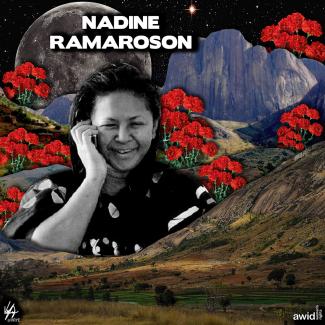
Son soutien aux femmes et aux personnes les plus vulnérables de sa communauté a fait que Nadine était un modèle pour beaucoup. Elle était déterminée à aider les pauvres et les sans-abri en particulier.
Bien que sa mort ait été déclarée comme étant accidentelle, la famille Ramaroson, sur l’initiative de son père André Ramaroson, a mené une enquête qui a mis en évidence des preuves de son assassinat. Elle serait décédée dans un accident mortel survenu entre Soanierano - Ivongo et Ste Marie - une histoire qui a été réfutée par sa famille. Elle avait reçu de nombreuses menaces de mort pour ses positions politiques résolues. L’affaire est toujours en cours auprès des tribunaux à Antananarivo (la capitale de Madagascar).
Promouvoir les programmes féministes : principales avancées en matière de genre et de sexualité
Chapitre 1
Alors que les fondamentalismes, les fascismes et autres systèmes d’oppression se métamorphosent et trouvent de nouvelles tactiques et stratégies pour consolider leur pouvoir et influence, les mouvements féministes persévèrent et célèbrent leurs victoires nationales, régionales et internationales.
La reconnaissance en 2019 par le Conseil des droits de l’Homme du droit à l’intégrité et à l’autonomie corporelles, par exemple, a marqué une étape cruciale. Des résolutions du Conseil sur la discrimination envers les femmes et les filles admettent cependant un recul lié à des groupes de pression rétrogrades, des conceptions idéologiques ou un détournement de la culture ou la religion pour s’opposer à l’égalité de leurs droits. Des avancées féministes sont aussi notées dans le travail des Procédures spéciales, qui soulignent notamment l’obligation des États de contrer les doctrines de l’idéologie du genre, rappellent à l’ordre les antidroits qui détournent des références à la « culture », et signalent que les convictions religieuses ne peuvent pas servir à justifier la violence ou la discrimination.
Sommaire
Niveau national
Sphères mondiales
Exercice : Cartographions et célébrons nos victoires!
Tengo la convicción de que las mujeres empoderadas dotan de empoderamiento a otras mujeres, y es por ello que la he pasado tan bien como afiliada de AWID. Todo lo que sé y lo que entiendo de feminismo e interseccionalidad se ha ampliado gracias a los contactos que tuve como parte del Equipo de la Calle de la Comunidad AWID. Espero que más mujeres se sumen y compartan temas e ideas que ayuden a otras mujeres. - Loyiso Lindani, Sudáfrica.
Cuando se hace una búsqueda en Internet sobre «mutilación genital femenina» o «MGF», junto a la entrada de Wikipedia, aparece una imagen de cuatro dibujos lineales de la anatomía femenina, que ilustran cuatro tipos de violencia. (...)
« J’ai constaté la discrimination dans la rue, que ce soit par des taquineries ou des agressions verbales qui y ont lieu. Je me suis aussi faite plein d’ami·e·s et j’y ai rencontré plusieurs personnes. Il se peut que ce soit dangereux là-bas, mais je suis une survivante, et pour le moment, c’est là où je suis. » - Sainimili Naival
Sainimili Naivalu était une activiste féministe des droits des personnes handicapées issue du village de Dakuibeqa, sur l’île de Beqa aux Fidji.
Elle a demandé aux responsables et acteurs politiques de fournir des politiques et des services adaptés au handicap, comme la construction de rampes dans les villes et les villages afin d'accroître leur accessibilité. Les barrières physiques n’étaient pas les seules qu’elle aspirait à modifier. Sur la base de sa propre expérience, elle savait que des changements plus difficiles devaient être menés dans les sphères économiques et sociales. Bon nombre des défis avec lesquels sont aux prises les personnes handicapées trouvent leurs racines dans les attitudes discriminantes et stigmatisantes.
Survivante et combattante, Sainimili a contribué à co-créer des réalités féministes qui renforcent l’inclusion et font évoluer les attitudes par rapport à l’égalité des personnes handicapées. Elle a été membre de la Spinal Injury Association of Fiji (SIA) ainsi que participé à la formation « Démarrez votre entreprise » de l’Organisation internationale du Travail à Suva via le projet « Pacific Enable » (le Pacifique rend possible) du Forum Asie-Pacifique sur le handicap. Elle a ainsi pu transformer ses idées en une entreprise qui lui était propre. Elle était commerçante sur l’étal de marché 7 de Suva, offrant des services de manucure, tout en gérant un stand au marché des femmes SIA pour y vendre de l’artisanat, des suls et des objets historiques. Sainimili planifiait d’élargir son commerce et de devenir une employeuse majeure de personnes handicapées.
Outre son activisme, elle était également médaillée de tennis de table et une récente championne.
Avec sa personnalité vive, Sainimili était unique. On savait toujours lorsqu’elle était dans la pièce car ses rires et ses histoires étaient la première chose qu’on pouvait remarquer. - Michelle Reddy
Illumination by the Light of the Full Moon: An African BDSM experience
Akosua Hanson is an artistic activist, based in Accra, Ghana. Her work spans radio, television, print media, theatre, film, comic art exhibitions, art installations, and graphic novels. Akosua’s activism has been centred around pan-Africanism and feminism, with an interest in the intersection of art, pop culture, and activism. She has a Masters in Philosophy in African Studies with a focus on Gender and African Philosophical Thought. Akosua Hanson is the creator of Moongirls, a graphic novel series that follows the adventures of four superheroes fighting for an Africa free from corruption, neocolonialism, religious fundamentalism, rape culture, homophobia and more. She works as a radio host at Y 107.9 FM, Ghana.
Ever experienced moments of deep clarity during or after sex?
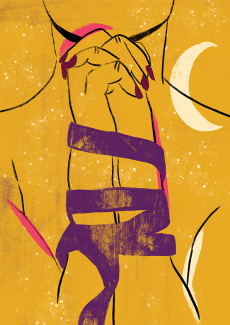
In these panels, the Moongirl Wadjet is engaged in BDSM lovemaking with a two-gender daemon. Of the four Moongirls, Wadjet is the healer and philosopher, the conduit of the Oracle. She does this to launch a scientific and spiritual process – an experiment she calls “Illumination by the Light of the Full Moon” – through which she traces a vibrational time arc between her memories, sensations, emotions, visions, and imagination. It is a form of vibrational time travel in order to discover what she terms as “truth-revelations.”
During the experience, some of Wadjet’s hazy visions include: an approaching apocalypse brought about by humans’ environmental destruction in service to a voracious capitalism; a childhood memory of being hospitalized after a mental health diagnosis; and a vision of a Moongirls’ origin story of the Biblical figure of Noah as an ancient black Moongirl warning of the dangers of environmental pollution.
More than a fun kink to explore for the sensations, BDSM can be a way of addressing emotional pain and trauma. It has been a medium of sexual healing for me, providing a radical form of liberation. There is a purge that happens when physical pain is inflicted on the body. Inflicted with consent, it draws out emotional pain – almost like a “calling forth.” The whip on my body allows me to release suppressed emotions: anxiety, depression, my sense of defenselessness to the stresses that overwhelm me sometimes.
When engaging in BDSM as an avenue for healing, lovers must learn to be very aware of and responsible for each other. Because even though consent may have been initially given, we must be attentive to any changes that might occur in the process, especially as feelings intensify. I approach BDSM with the understanding that in order to surrender pain, love and empathy have to be the basis of the process and by that, I create space or open up for love.
The engagement with aftercare after the infliction of pain is a completion of the process. This can be done in very simple ways such as cuddling, checking if they need water, watching a movie together, sharing a hug or just sharing a joint. It can be whatever your chosen love language is. This holding space, with the understanding that wounds have been opened, is necessary to complete the process of healing. It is the biggest lesson in practising empathy and learning to really hold your partner, due to the delicacy in blurring the lines between pain and pleasure. In this way, BDSM is a form of care work for me.
After BDSM sex, I feel a clarity and calm that puts me in a great creative space and spiritually empowers me. It is an almost magical experience watching the pain transform into something else in real time. Similarly, this personally liberating experience of BDSM allows Wadjet to access the foreknowledge, wisdom, and clarity to aid in her moongirl duties in fighting African patriarchy.
Moongirls was birthed during my tenure as the director for Drama Queens, a young artistic activist organization based in Ghana. Since our inception in 2016, we’ve employed different artistic media as part of their feminist, pan-Africanist, and environmentalist activism. We used poetry, short stories, theatre, film, and music to address issues such as corruption, patriarchy, environmental degradation, and homophobia.
Our inaugural theatre production, “The Seamstress of St. Francis Street” and “Until Someone Wakes Up” addressed the problem of rape culture in our communities. Another one, “Just Like Us,” was arguably one of the first Ghanaian theatre productions to directly address the country’s deep-seated issue of homophobia. Queer Universities Ghana, our queer film workshop for African filmmakers, has trained filmmakers from Ghana, Nigeria, South Africa, and Uganda. Films birthed during the workshop, like “Baby Girl: An Intersex Story” by Selassie Djamey, have gone on to be screened at film festivals. Therefore, moving to the medium of graphic novels was a natural progression.
About seven years ago, I’d started a novel that I never completed about the lives of four women. In 2018, the Open Society Initiative for West Africa (OSIWA) opened up a grant opportunity that launched the production of the project and my uncompleted novel was turned into Moongirls.
There have been two seasons of Moongirls made up of six chapters each. Contributing writers and editors for the first season were Suhaida Dramani, Tsiddi Can-Tamakloe, George Hanson, and Wanlov the Kubolor. Writers for the second season were Yaba Armah, Nadia Ahidjo, and myself. Character illustrations and conceptualizations were by Ghanaian artist Kissiwa. And AnimaxFYB Studio, a premium animation, design, and visual effects studio, does the illustrations.
During the experience, some of Wadjet’s hazy visions include: an approaching apocalypse brought about by humans’ environmental destruction in service to a voracious capitalism; a childhood memory of being hospitalized after a mental health diagnosis; and a vision of a Moongirls’ origin story of the Biblical figure of Noah as an ancient black Moongirl warning of the dangers of environmental pollution.
Writing Moongirls between 2018 and 2022 has been a labour of love for me, even, a labour for liberation. I aim to be very explorative in form and style: I’ve dabbled in converting other forms of writing, such as short stories and poetry, to graphic novel format. By merging illustration and text, as graphic novels do, Moongirls aims to tackle the big issues and to honor real life activists. My decision to centre queer women superheroes – which is rare to see in this canon – came to mean so much more when a dangerous backdrop started developing in Ghana in 2021.
Last year saw a marked hike in violence for the Ghanaian LGBT+ community that was sparked by the shutdown of an LGBT+ community centre. This was followed by arbitrary arrests and imprisonment of people suspected to be on the queer spectrum, as well as of those accused of pushing an “LGBT agenda.” Crowning this was the introduction in Ghanaian Parliament of an anti-LGBT bill named “Proper Human Sexual Rights and Ghanaian Family Values.” This bill is arguably the most draconian anti-LGBT bill ever drafted in the region, following previous attempts in countries like Nigeria, Uganda and Kenya.
I remember quite vividly the first time I read the draft of this bill.
It was a Friday night, typically a night I take off to rest or party after a long work week. By sheer luck, the draft was leaked and shared with me on a WhatsApp group. As I read it, a deep sense of fear and alarm made burnt toast of my Friday night chill. This bill proposed to slap any LGBT+ advocacy with five to ten years of imprisonment, and to fine and imprison people who identify as LGBT+ unless they “recanted” and accepted conversion therapy. In the draft bill, even asexual people were criminalized. The bill went for all fundamental freedoms: freedoms of thought, of being, and the freedom to hold one’s personal truth and choose to live your life by that truth. The bill even went for social media and art. If it passed, Moongirls would be banned literature. What the bill proposed to do was so evil and far-reaching, I was stunned into a depression at the depth of hate from which it had been crafted.
Scrolling through my Twitter timeline that night, the terror I felt inside me was mirrored. The timeline was a livestream of emotions as people reacted in real time to what they were reading: disbelief to terror to a deep disappointment and sorrow when we realized how far the bill wanted to go. Some tweeted their readiness to fold up and leave the country. Then, in the way Ghanaians do, sorrow and fear is alchemized to humour. From humour came the zest to upscale the fight.
So, the work still continues. I created Moongirls to provide an alternative form of education, to provide knowledge where it has been suppressed by violent patriarchy, and to create visibility where the LGBT+ community has been erased. It is also important that African BDSM is given this platform of representation when so much of BDSM representation is white. Sexual pleasure, through BDSM or otherwise, as well as non-heterosexual love, transcend race and continent because sexual pleasure and its diversity of experience are as old as time.
Snippet FEA Intro Acknowledgments (FR)
Nous tenons à remercier le collectif Amar.ela de femmes féministes militantes et créatives qui ont rendu cette série possible, et tout particulièrement Natalia Mallo (le poulpe de l'équipe) pour son soutien et son accompagnement dans ce voyage.
Nous exprimons également notre profonde gratitude et notre admiration à tous les groupes et personnes qui ont participé à ce projet, et nous les remercions d'avoir partagé leur temps, leur sagesse, leurs rêves et leurs illusions avec nous. Nous les remercions de faire de ce monde un monde plus juste, féministe et durable.
Nous espérons que leurs histoires inspireront le reste du monde autant qu’elles nous ont inspirés.
Snippet - Blog post Quote_EN
"We believe that this is the time for us to continue to organize from a place of solidarity, hope and radical imaginations."
- Beijing+30 & CSW: Feminist meaning-making at a time of polycrisis
Esmeralda aux contrôles d’Internet : comment les réseaux sociaux aident les femmes roms à gagner en visibilité
par Émilie Herbert-Pontonnier
Vous vous souvenez d’Esmeralda? Cette héroïne « gitane » et exotique née sous la plume de Victor Hugo, géant de la littérature française, et rendue célèbre par les studios Disney et leur Bossu de Notre-Dame. (...)
“But when was the master
ever seduced from power?
When was a system ever broken
by acceptance?
when will the BOSS hand you power with love?
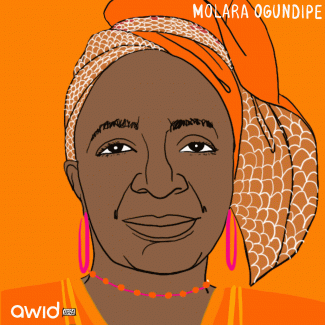
At Jo’Burg, at Cancun or the U.N? – Molara Ogundipe
In an interview at the 2010 Ghana International Book Fair, Molara Ogundipe introduced herself with the words: “...I’m a Nigerian. I’ve lived possibly all over the world except for the Soviet Union and China.”
Across the different continents and countries, Professor Ogundipe taught comparative literature, writing, gender, and English studies using literature as a vehicle for social transformation and re-thinking gender relations.
A feminist thinker, writer, editor, social critic, poet, and activist Molara Ogundipe succeeded in combining theoretical work with creativity and practical action. She is considered to be one of the leading critical voices on African feminism(s), gender studies and literary theory.
Molara famously coined the concept of “stiwanism’ from the acronym STIWA – Social Transformations in Africa Including Women recognizing the need to move “away from defining feminism and feminisms in relation to Euro-America or elsewhere, and from declaiming loyalties or disloyalties.”
In her seminal work ‘Re-creating Ourselves’ in 1994, Molara Ogundipe (published under Molara Ogundipe-Leslie) left behind an immense body of knowledge that decolonized feminist discourse and “re-centered African women in their full, complex narratives...guided by an exploration of economic, political and social liberation of African women and restoration of female agency across different cultures in Africa.”
In speaking about the challenges she faced as a young academic she said:
”When I began talking and writing feminism in the late sixties and seventies, I was seen as a good and admirable girl who had gone astray, a woman whose head has been spoilt by too much learning".
Molara Ogundipe stood out for her leadership in combining activism and academia; in 1977 she was among the founding members of AAWORD, the Association of Women in Research and Development. In 1982 she founded WIN (Women In Nigeria) to advocate for full “economic, social and political rights” for Nigerian women. She then went on to establish and direct the Foundation for International Education and Monitoring and spent many years on the editorial board of The Guardian.
Growing up with the Yoruba people, their traditions, culture, and language she once said :
“I think the celebration of life, of people who pass away after an achieved life is one of the beautiful aspects of Yoruba culture.”
Molara’s Yoruba ‘Oiki’ praise name was Ayike. She was born on 27 December 1940 and at the age of 78, Molara passed away on 18 June 2019 in Ijebu-Igbo, Ogun State, Nigeria.
Let the invisible be visible: A Genderfluid Bodybuilder’s Manifesto in Hong Kong
by Siufung Law
“97..! 98.. where is 98? 98! Please come back to the lineup!... 99! 100!...” The backstage lady relentlessly asked each athlete to queue up at the humid, sweaty, overcrowded backstage. (...)