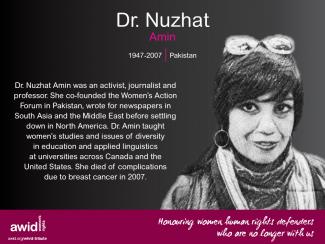
Flor Alba Nunez Vargas
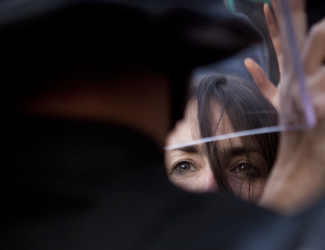
WHRDs are self-identified women and lesbian, bisexual, transgender, queer and intersex (LBTQI) people and others who defend rights and are subject to gender-specific risks and threats due to their human rights work and/or as a direct consequence of their gender identity or sexual orientation.
WHRDs are subject to systematic violence and discrimination due to their identities and unyielding struggles for rights, equality and justice.
The WHRD Program collaborates with international and regional partners as well as the AWID membership to raise awareness about these risks and threats, advocate for feminist and holistic measures of protection and safety, and actively promote a culture of self-care and collective well being in our movements.
WHRDs are exposed to the same types of risks that all other defenders who defend human rights, communities, and the environment face. However, they are also exposed to gender-based violence and gender-specific risks because they challenge existing gender norms within their communities and societies.
We work collaboratively with international and regional networks and our membership
We aim to contribute to a safer world for WHRDs, their families and communities. We believe that action for rights and justice should not put WHRDs at risk; it should be appreciated and celebrated.
Promoting collaboration and coordination among human rights and women’s rights organizations at the international level to strengthen responses concerning safety and wellbeing of WHRDs.
Supporting regional networks of WHRDs and their organizations, such as the Mesoamerican Initiative for WHRDs and the WHRD Middle East and North Africa Coalition, in promoting and strengthening collective action for protection - emphasizing the establishment of solidarity and protection networks, the promotion of self-care, and advocacy and mobilization for the safety of WHRDs;
Increasing the visibility and recognition of WHRDs and their struggles, as well as the risks that they encounter by documenting the attacks that they face, and researching, producing, and disseminating information on their struggles, strategies, and challenges:
Mobilizing urgent responses of international solidarity for WHRDs at risk through our international and regional networks, and our active membership.
avec Luam Kidane, Mariama Sonko, Yannia Sofia Garzon Valencia et Nomsa Sizani.
Mientras les líderes se reúnen en Brasil, es fundamental que los movimientos feministas, sobre todo los de la mayoría global, contemos con espacios autónomos para encontrarnos, elaborar estrategias y trastocar.
En estos nodos interpelamos el elitismo de las conversaciones sobre el clima, nos centramos en las vivencias y apuntamos a construir el poder colectivo más allá de las fronteras. Se ofrece un contrapeso crítico a las negociaciones internacionales jerárquicas y a menudo excluyentes. En los nodos buscamos promover las soluciones nacidas de la comunidad, amplificar las demandas feministas y garantizar que los principios feministas de los cuidados y la solidaridad sean los que den forma a la agenda por el clima. No se trata únicamente de tener presencia en la COP30, se trata también de reconfigurar las conversaciones sobre la justicia climática en términos feministas.
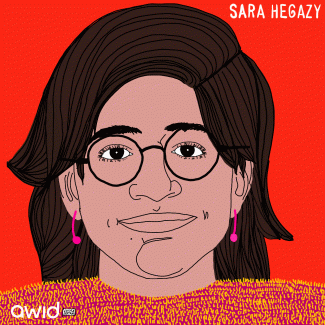
Sara Hegazy, une audacieuse activiste égyptienne des droits des LGBTQI+, vivait dans une société où les membres de sa communauté, leurs corps et leurs vies sont souvent victimes de préjugés mortels. La résistance de Sara puise ses racines dans le processus de déconstruction d'un système dominant, oppressif et patriarcal, et de ses acteurs antidroits.
« [En Égypte], toute personne qui n'est pas un homme, musulman, sunnite, hétéro et partisan du système, est rejetée, réprimée, stigmatisée, arrêtée, exilée ou tuée. Ce phénomène concerne le système patriarcal dans son ensemble, étant donné que l'État ne peut pratiquer sa répression contre les citoyens sans une oppression préexistant depuis l'enfance », écrivait Sara Hegazy le 6 mars 2020
La répression de la voix de Sara par le gouvernement égyptien atteignit son paroxysme en 2017, lorsqu’elle fut arrêtée pour avoir brandi un drapeau arc-en-ciel lors du concert de Mashrou' Leila (groupe libanais dont le chanteur principal est ouvertement gai) au Caire. Elle fut ensuite accusée d'avoir rejoint un groupe illégal et « d’incitation à la déviance sexuelle et à la débauche ».
« C’était un acte de soutien et de solidarité, non seulement envers le chanteur [de Mashrou' Leila] mais pour tou·te·s les opprimé·e·s… Nous étions fier·ère·s de porter le drapeau. Nous ne pouvions imaginer que la société et l’État égyptien réagiraient de cette façon. Ils m’ont vue comme une criminelle, quelqu’un qui cherchait à détruire la structure morale de la société ». - Sara Hegazy
Sara fut emprisonnée pendant trois mois, durant lesquels elle fut torturée et agressée sexuellement. En janvier 2018, après avoir été libérée sous caution, elle demanda l'asile au Canada où elle vécut en sécurité mais resta prisonnière des souvenirs de la violence et des sévices qu'elle avait subis dans son corps et son âme.
« Je suis sortie de cette expérience au bout de trois mois avec un cas très sévère et grave de SSPT [syndrome de stress post-traumatique]. La prison m'a tuée. Elle m'a détruite », déclara Sara Hegazy à la NPR (Radio d’État)
Sara s'est suicidée le 14 juin 2020, en laissant une note manuscrite en arabe :
« À mes frères et sœurs - j'ai essayé de trouver la rédemption et j'ai échoué, pardonnez-moi. »
« À mes amis - l'expérience [l’aventure] a été rude et je suis trop faible pour la supporter, pardonnez-moi. »
« Au monde - tu as été très cruel, mais je te pardonne. »
Son courage et son héritage seront perpétués par toutes les personnes qui l’aimaient et qui croient en ce pour quoi elle s’est battue.
« À Sara : repose-toi, repose-toi simplement, hors d’atteinte de cette violence implacable, de ce patriarcat étatique meurtrier. Dans la rage, dans le chagrin, dans l'épuisement, nous résisterons. » - Rasha Younes, chercheuse sur les droits LGBT à Human Rights Watch. Lisez le texte complet
Le chanteur de Mashrou’ Leila chante en hommage à Sara Hegazy
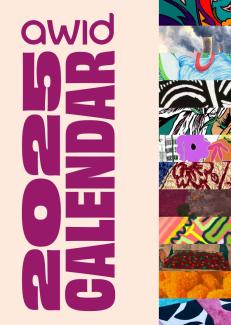
Ce calendrier est un cadeau que nous vous faisons à vous et aux 8 000 membres de notre communauté féministe mondiale. C’est notre promesse de moments d’activisme et de connexion pour l’année à venir. Ces derniers mois ont porté leur lot d’injustices indescriptibles. Cette année encore, continuons à cultiver la puissance du collectif, à établir des stratégies et à trouver des solutions porteuses d’espoir. Pour un monde plus juste pour toustes.
En feuilletant les pages de ce calendrier, vous remarquerez la diversité des œuvres de nos membres artistes, qui se servent de leur travail pour amplifier et relier nos différents mouvements sous le parapluie féministe. Vous retrouvez-vous dans ces pages ? Y retrouvez-vous votre mouvement, vos communautés ? Nous vous encourageons à utiliser ce calendrier utile pour marquer le temps, l’espace, mais aussi pour inscrire les possibilités d’établir des connexions avec les féministes et les activistes.
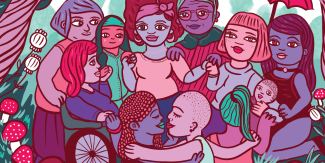

“My mission in life is not merely to survive, but to thrive; and to do so with some passion, some compassion, some humor, and some style.” - Maya Angelou
The International AWID Forum is both a global community event and a space of radical personal transformation. A one-of-a-kind convening, the Forum brings together feminist, women’s rights, gender justice, LBTQI+ and allied movements, in all our diversity and humanity, to connect, heal and thrive. The Forum is a place where Global South feminists and historically marginalized communities take center stage, strategizing with each other and social justice movements, in order to shift power, make strategic alliances, and usher in a different, better world. When people come together on a global scale, as individuals and movements, we generate a sweeping force. Join us in Bangkok, Thailand in 2024. Come dance, sing, dream and rise with us.
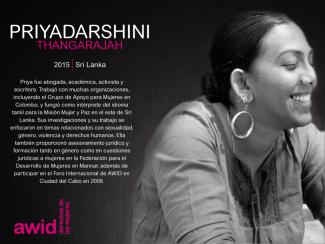
Chinelo Onwualu est une conseillère éditoriale ayant près de 10 ans d’expérience dans l’élaboration de communications stratégiques pour des organisations à but non lucratif du monde entier. Elle a notamment travaillé pour ActionAid Nigeria, The BBC World Trust, Open Society Initiative for West Africa (OSIWA) et l’AWID. Elle est titulaire d’un master en journalisme de l’Université de Syracuse et a travaillé comme rédactrice, éditrice et chercheuse au Nigeria, au Canada et aux États-Unis. Elle est également l’éditrice non-romanesque du magazine Anathema et cofondatrice d’Omenana, un magazine de fiction spéculative africaine. Ses nouvelles ont été publiées dans plusieurs anthologies primées et elle a été nominée pour les British Science Fiction Awards, les Nommo Awards for African Speculative Fiction et le Short Story Day Africa Award. Elle est originaire du Nigeria mais vit à Toronto avec son compagnon et son enfant.
Una herramienta para activistas feministas presentes en la COP30 que luchan por soluciones transformadoras, equitativas y comunitarias para responder a la crisis climática.

Con el propósito de cumplir su misión, AWID trabaja a través de programas multianuales interconectados.
Cada programa comprende diversas estrategias que abarcan desde la generación y difusión de conocimientos, investigación aplicada, incidencia política y formación de alianzas, hasta convocatorias a diálogos estratégicos.
En nuestro Informe Anual 2011 encontrarán una síntesis de los principales logros alcanzados en cada una de los programas de AWID durante el año.
Las realidades feministas son ejemplos palpables de los mundos justos que estamos creando conjuntamente. Existen ahora, en las múltiples formas en que vivimos, luchamos y construimos nuestras vidas.
Estas realidades feministas van más allá de la resistencia contra los sistemas de opresión, y nos muestran cómo sería un mundo sin dominación, ni explotación ni supremacía.
Estas son las historias que queremos descubrir, compartir y ampliar a lo largo de este viaje por las realidades feministas.
Creamos y difundimos alternativas: Creamos juntxs arte y expresiones creativas se centran en celebrar la esperanza, el optimismo, la sanación y la imaginación radical que inspiran las realidades feministas.
Construimos conocimiento: Documentamos, demostramos y difundimos metodologías que ayudarán a identificar las realidades feministas en nuestras diferentes comunidades.
Promovemos agendas feministas: Expandimos y profundizamos nuestro pensamiento colectivo y nuestra organización para promover soluciones y sistemas justos que encarnen valores y visiones feministas.
Movilizamos acciones solidarias: Involucramos a movimientos feministas, de derechos de las mujeres, de justicia de género y aliados para que compartan, intercambien y creen juntos realidades, narrativas y propuestas feministas en el 14º Foro Internacional de AWID.
Aunque ponemos énfasis en el proceso que lleva al Foro y en lo que ocurre después, el evento de cuatro días es un espacio importante en el que ocurre la magia que queremos crear, gracias a la energía única que despierta y a las oportunidades que se abren cuando nos reunimos.
Les dé fuerza a las Realidades Feministas al nombrarlas, celebrarlas y generar entusiasmo por las experiencias y propuestas que nos muestran de qué somos capaces, alimentando así nuestra imaginación colectiva.
Nos llene de esperanza y de energía que son combustibles tan necesarios para la resiliencia y el activismo por los derechos y la justicia
Fortalezca las conexiones, la reciprocidad y la solidaridad entre los diversos movimientos feministas, y entre ellos y otros movimientos por los derechos y la justicia
Aquí podrás leer más acerca del proceso del Foro
Follow the campaign:
Join us!
Join our Membership| Join AWID Community
Stay updated
Questions?
Contact us: communications @ awid.org

Nous avons redoublé d’efforts pour préparer le 13e Forum de l’AWID ; nous avons consacré une grande partie de notre énergie au Programme de développement pour l’après-2015 et aux processus des Nations Unies relatifs au financement du développement. Nous avons poursuivi le travail de fond que nous menons dans nos domaines de prédilection.
En réaction, nous avons choisi de sortir de nos cloisonnements.
De plus en plus, et dans le monde entier, les mouvements de défense des droits des femmes s’allient avec d’autres mouvements pour exprimer la nature systémique et intersectionnelle des problèmes précédemment évoqués et d’autres problématiques.

We welcome applications across the full range of thematic areas and intersections important to feminist and gender justice movements.