Confronting Extractivism & Corporate Power
Women human rights defenders (WHRDs) worldwide defend their lands, livelihoods and communities from extractive industries and corporate power. They stand against powerful economic and political interests driving land theft, displacement of communities, loss of livelihoods, and environmental degradation.
Why resist extractive industries?
Extractivism is an economic and political model of development that commodifies nature and prioritizes profit over human rights and the environment. Rooted in colonial history, it reinforces social and economic inequalities locally and globally. Often, Black, rural and Indigenous women are the most affected by extractivism, and are largely excluded from decision-making. Defying these patriarchal and neo-colonial forces, women rise in defense of rights, lands, people and nature.
Critical risks and gender-specific violence
WHRDs confronting extractive industries experience a range of risks, threats and violations, including criminalization, stigmatization, violence and intimidation. Their stories reveal a strong aspect of gendered and sexualized violence. Perpetrators include state and local authorities, corporations, police, military, paramilitary and private security forces, and at times their own communities.
Acting together
AWID and the Women Human Rights Defenders International Coalition (WHRD-IC) are pleased to announce “Women Human Rights Defenders Confronting Extractivism and Corporate Power”; a cross-regional research project documenting the lived experiences of WHRDs from Asia, Africa and Latin America.
We encourage activists, members of social movements, organized civil society, donors and policy makers to read and use these products for advocacy, education and inspiration.
-
"Women Human Rights Defenders confronting extractive industries: an overview of critical risks and Human Rights obligations" is a policy report with a gender perspective. It analyses forms of violations and types of perpetrators, quotes relevant human rights obligations and includes policy recommendations to states, corporations, civil society and donors.
-
"Weaving resistance through action: Strategies of Women Human Rights Defenders confronting extractive industries" is a practical guide outlining creative and deliberate forms of action, successful tactics and inspiring stories of resistance.
-
The video “Defending people and planet: Women confronting extractive industries” puts courageous WHRDs from Africa, Asia, and Latin America in the spotlight. They share their struggles for land and life, and speak to the risks and challenges they face in their activism.
-
Challenging corporate power: Struggles for women’s rights, economic and gender justice is a research paper outlining the impacts of corporate power and offering insights into strategies of resistance.
Share your experience and questions!
◾️ How can these resources support your activism and advocacy?
◾️ What additional information or knowledge do you need to make the best use of these resources?
Thank you!
AWID acknowledges with gratitude the invaluable input of every Woman Human Rights Defender who participated in this project. This project was made possible thanks to your willingness to generously and openly share your experiences and learnings. Your courage, creativity and resilience is an inspiration for us all. Thank you!
Related Content
Soy nueva en este campo y existen muchos términos que me resultan confusos, ¿me pueden ayudar?
Remembering: A Tribute to WHRDs no longer with us
AWID honors feminists and Women Human Rights Defenders (WHRDs) who have died and whose contributions to the advancement of human rights are very much missed.
Celebrating Activists and WHRDs
AWID’s WHRD Tribute is a photo exhibition featuring feminist, women’s rights and social justice activists from around the world who are no longer with us.
The Tribute was first launched in 2012, at AWID’s 12th International Forum, in Turkey. It took shape with a physical exhibit of portraits and biographies of feminists and activists who passed away. The initiative was described by Forum participants as being a unique, moving and energizing way to commemorate our collective history.
At the 13th International Forum in Brazil, we honored activists and WHRDs with a mural unveiling ceremony in four languages, a dance performance and a Brazilian ritual.
In between the events, the Tribute lives as an online gallery that is updated every year as part of the 16 Days Campaign Against Gender Based Violence (25 November – 10 December).
Contributions from all over the world
Since 2012, through our annual Tribute to Women Human Rights Defenders (WHRDs) no longer with us, over 400 feminists and WHRDs from 11 regions and 80 countries have been featured.
AWID would like to thank the families and organizations who shared their personal stories and contributed to this memorial. We join them in continuing the remarkable work of these women and forging efforts to ensure justice is achieved in cases that remain in impunity.
Visit the WHRD Tribute online exhibit
The violence and threaths against WHRDs persist
In addition to paying homage to these incredible activists, the Tribute particularly sheds light on the plight of WHRDs who have been assassinated or disappeared.
One third of those featured in the Tribute were activists who have been murdered or disappeared in suspicious circumstances. They were specifically targeted for who they were and the work they did to challenge:
- State power
- Heteronormativity
- Fundamentalisms
- Corporations
- Patriarchy
- Organized Crime
- Corruption
- Militarization…
Women like Agnes Torres, from Mexico, was killed because of her gender identity and sexual orientation; or Cheryl Ananayo, an environmental activist from the Philippines was assassinated as she struggled against a mining company; or Ruqia Hassan, a Syrian independent journalist and blogger killed for her criticism of ISIS. And so many others.
With the WHRD Tribute, we bring them all into our collective memory and carry their legacy of struggle as our torch in the feminists’ and women’s rights movements. We recognize that security, safety and self-care must be a priority in all our political agendas. And we call on to governments and international bodies to collectively address violence against feminists and WHRDs.
We believe this is a critical step to ensure the sustainability of our movements for gender equality, women’s rights, and justice for all.
Snippet - CSW69 On feminist resourcing today - ES
Sobre la dotación de recursos feministas de hoy
- Responde el quiz "¿Dónde está el dinero?" aquí
- Our Resource (en inglés)
- Recursos autónomos: ¿Cómo lxs activistas podemos dotar de recursos a nuestro activismo?
- Qué podemos aprender de lxs feministas que se autofinancian
Snippet FEA Mariama Sonko (FR)
Nous avons le plaisir de vous présenter Mariama Sonko, agricultrice rurale, éco-féministe et défenseuse des droits humains, vivant actuellement à Niaguis, une ville du sud-ouest du Sénégal.
Ayant grandi dans une famille et une communauté rurale d’agriculteur·rices, elle a été témoin du rôle essentiel des femmes dans la production alimentaire et la conservation des semences depuis son plus jeune âge, tout en étant immergée dans le travail de la terre.
Mariama défend les savoirs agricoles locaux et les pratiques paysannes depuis les années 90. En tant que mère de 5 enfants, la nourriture qu'elle cultive elle-même est la principale source de subsistance de sa famille.
Elle est actuellement présidente de Nous Sommes la Solution et s'engage à promouvoir les pratiques agroécologiques et l'agriculture familiale, à encourager la souveraineté alimentaire, la biodiversité et la préservation des semences paysannes, et à exiger un accès équitable aux ressources et à la terre à travers l'Afrique de l'Ouest.
Source: AWID’s Feminist Realities Festival Crear | Résister | Transform - Day 2/ 2ème jour/ 2º día
Lina Ben Mhenni
«Quiero transmitir el siguiente mensaje a todos los tunecinos y tunecinas: Tenemos que unirnos para decir no a la censura y a los juicios contra el derecho a opinar.» - Lina Ben Mhenni (entrevista de 2013)
«Es cierto que la información y la Internet son importantes, pero para hacer una revolución es crucial estar en el territorio. Algunas personas aquí en Túnez piensan que el cambio se dará mediante un simple “me gusta” en Internet. Yo creo que hay que estar activxs en el terreno. Y, por supuesto, que hay que combinar las acciones en el terreno con la acción en las redes.» - Lina Ben Mhenni (entrevista en POCIT)
En 2010 co-organizó una protesta que desafió la decisión gubernamental de suprimir medios de comunicación e instalar la censura de Internet. Lina era muy conocida por su blog «A Tunisian Girl», y por su trabajo durante la revolución tunecina de 2011. En su blog, difundió la información sobre el levantamiento, compartió imágenes que documentaban las protestas, y fue una de las pocas voces que hablaron sobre los asesinatos y la represión de lxs manifestantes de Sidi Bouzid. Lina publicaba en su blog utilizando su nombre real en lugar de un seudónimo que protegiera su identidad, y fue una de lxs pocxs bloguerxs en hacerlo.
«Nuestra libertad de expresión corre verdadero peligro. Me temo que estamos perdiendo los extraordinarios frutos de la revolución: la desaparición del miedo y nuestra libertad de expresión. Tenemos que seguir luchando para proteger y preservar este derecho.» - Lina Ben Mhenni (entrevista de 2013)
Lina tenía solamente 36 años cuando falleció, el 27 de enero de 2020, debido a complicaciones derivadas de una enfermedad autoinmune.
«Libertad, mejor educación y mejor salud—eso era lo que todxs queríamos. Cuando fracasábamos, ella nos empujaba.» - Hala, maestra de Lina
Je vis une situation de violence au sein de l’une ou plusieurs relations interpersonnelles. Est-ce que l’AWID peut m’aider ?
L’AWID n’est pas une organisation de services de première ligne, ni de défense de la personne
Nous vous conseillons de demander conseil à un-e avocat-e, de communiquer avec un refuge pour femmes ou un centre d’accueil près de chez vous.
Les HotPeachPages, une ressource en ligne, contiennent des liens vers les refuges pour femmes dans le monde entier. L’AWID ne peut garantir l’exactitude ou la qualité de ces listes, mais elles peuvent constituer un bon point de départ si vous ne connaissez aucune organisation près de chez vous.
En su lucha por los derechos humanos enfrentan la injusticia en América Latina
Este año honramos a 19 defensoras de la región de América Latina y el Caribe. De ellas, 16 fueron asesinadas, incluyendo a 6 periodistas y 4 defensoras LGBTQI. Únete a nosotras en la conmemoración de sus vidas y trabajo, compartiendo los memes aquí incluidos con tus colegas, amistades y redes; y tuiteando las etiquetas #WHRDTribute y #16Días.
Por favor, haz click en cada imagen de abajo para ver una versión más grande y para descargar como un archivo.


Snippet - CSW69 - What Can Feminist Movements Learn - EN
What Can Feminist Movements Today Learn from Beijing 1995?
✉️ By registration only. Register here
📅 Wednesday, March 12, 2025
🕒 6.30–8:00pm EST
🏢 Church Center of the United Nations, 777 United Nations Plaza, New York, NY 10017
🎙️Co-facilitated by: Inna Michaeli, Co-Executive Director
Organizer: Jass, Gender at Work, and Count Me In! Consortium
Snippet FEA Bio fertilizer and Sum-Pack (EN)

Heike Jensen
Gloria Chicaiza
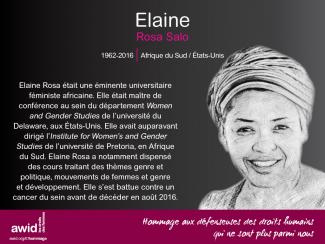
Activiste sociale et de l’environnement équatorienne, Gloria Chicaiza était une fervente défenseuse du droit à la terre et à l’eau. Elle s’est opposée au statu quo en luttant contre un modèle de développement fondé sur l’extraction et a oeuvré sans relâche pour la justice écologique et les droits des communautés affectées par l’exploitation minière.
Dans divers endroits de l’Équateur, Gloria a participé à des actions de résistance en faveur de la protection de l’écosystème. Avec passion et dévouement, Goria a apporté son soutien au mouvement autochtone et environnemental, à ces communautés et organisations qui s’opposent aux projets miniers et protègent leurs territoires et leurs projets de vie collectifs. Elle est intervenue au sein de forums locaux et internationaux contre la criminalisation des dissident·e·s et des résistant·e·s, contre les pressions et la violence exercées à l’encontre des activistes communautaires, en particulier des femmes défenseuses des droits humains, et pour soutenir les efforts déployés par les communautés en faveur de la souveraineté alimentaire et de la durabilité.
Elle était la coordonnatrice de la justice minière à Acción Ecológica, membre du Réseau latino-américain des femmes défenseuses des droits sociaux et environnementaux, et membre du conseil d'administration de l'Observatoire latino-américain des conflits miniers.
En octobre 2010, Gloria a été accusée par la société minière Curimining/Salazar Resources S.A. (dont le siège est à Vancouver, au Canada) d’avoir commandité un acte de terrorisme, de sabotage et d’association illégale dans le but de commettre un crime. Acción Ecológica a estimé qu’il s’agissait là de “représailles pour son travail de dénonciation concernant l’impact des activités minières dans le pays”.
En 2015, Gloria a facilité la coordination d’une délégation, composée de 25 femmes autochtones d’Amérique latine, affectée au Dialogue sur le changement climatique de la COP 20 des Nations Unies.
Gloria est décédée le 28 décembre 2019 des suites de complications liées à une transplantation pulmonaire. On se souvient d’elle pour ses actes de résistance et son travail acharné.
"Le moyen le plus rapide de parvenir à la durabilité reste encore la résistance.” - Gloria Chicaiza (2010 interview)
Hommages :
“Pour GLORIA. GLORIA Eau. GLORIA Terre. GLORIA Mère. GLORIA Révolution. GLORIA Soeur. GLORIA Ciel. GLORIAmie. GLORIAstrale. Merci de nous avoir entrelacé·e·s.” -Liliana Gutierrez
“Merci Glorita, d’avoir nourri l'espoir, d’avoir préservé la solidité de la structure, d’avoir tissé des liens avec la communauté, pour les mains unies, pour la solidarité, merci Glorita de t’être tenue à nos côtés dans les moments les plus difficiles. Merci de nous avoir appris que tout au long de la vie, personne ne se fatigue.” (Chakana News)
“Gloria Chicaiza appréciait ne pas sortir du lot et s’y épanouissait. Et aussi humble qu'elle fût, elle avait une capacité inouïe à mener et garder un rythme régulier et étourdissant, un pouls de vie qui guidait, mobilisait et inspirait les communautés et les réseaux dans la protection de la Terre Mère. Elle a dénoncé toutes les formes de violence contre les “cuerpos-territorios” (les corps comme territoires). Elle soutenait le “buen vivir" (“bien vivre”). - Gabriela Jiménez, coordonnatrice des partenariats en Amérique latine, KAIROS
“Merci Gloria Chicaiza, nous sommes sûr·e·s que depuis l’infini, tu continueras à soutenir notre combat. Toi qui as continué de te battre en dépit de ta santé défaillante. Tu continueras de vivre dans les forêts et les eaux que tu as défendues avec tant de courage. Tu vivras dans nos coeurs.” - La communauté d’Intag en Équateur
2008: The Doha International Conference takes place with limited achievements
Follow-up International Conference on Financing for Development, Doha, Qatar
- The Doha conference aimed to review the implementation of the Monterrey Consensus. The conference revisited all six areas of financing for development but little substantive progress was achieved.
- While the outcome of Doha went beyond Monterrey on gender equality, it did not go far enough. A statement by the WWG on FfD highlighted that the commitments to gender equality in the Doha Declaration would only be meaningful if the systemic issues that underpin poverty and the unequal distribution of power and resources in the global political economy were decisively addressed.
- In addition to the main Doha conference, during their parallel forum the Civil Society under the Doha NGO Group (DNG) for Financing for Development demanded global economic structural changes, and policies that put peoples´ rights first and respect and promote human rights.
WHRDs from the South and Southeast Asian region
7 Women Human Rights Defenders from across the South and Southeast Asian region are honored in this year’s Online Tribute. These defenders have made key contributions to advancing human and women’s rights, indigenous people’s rights, and the right to education. These WHRDs were lawyers, women’s rights activists, scholars, and politicians. Please join AWID in commemorating t their work and legacy by sharing the memes below with your colleagues, networks and friends and by using the hashtags #WHRDTribute and #16Days.
Please click on each image below to see a larger version and download as a file


Snippet - WCFM Movement and Struggle - EN

Movement in focus:
Filter your search by funders’ priority support areas that speak to your organizing efforts
Snippet FEA FEMINIST COOPERATIVISM (ES)
Cooperativismo
Feminista
Cuando el trabajo y
la solidaridad van juntos
Carmela Elisarraraz Mendez
Aïssata Kane
Aïssata Kane, also fondly known as “Yaye Kadia” (Mother Kadia), was a feminist with a lifelong committment in advocating for African and especially Mauritanian women’s rights.
In her career as a politician, she was appointed Minister of Family Protection and Social Affairs in 1975, the first time a woman held such a position and in which Aïssata fervently worked to improve the status of women in her country.
This work included advancing girls’ and women’s education, fighting against the practice of force-feeding of young women, lobbying for an inclusion of a marital rights provision, and advocating for a female representation quota to be created in the Parliament.
“[Aïssata] realized all her passions with humility, courage and determination. She didn’t want to disturb anyone by her fight on all these fronts at the same time.” Ball Halimata Dem, Aïssata’s niece
She founded the National Union of Women of Mauritania (UNFM), co-creating and publishing Marienou for them, a magazine dedicated to the emancipation of Mauritanian women. Aïssata also directed several sub-regional and local organizations, including as the President of the International Association of Francophone Women (AIFF) and as a resolute ecologist, she was President of the Association for the Protection of the Environment in Mauritania (APEM).
In 2018 she received the Pioneer Woman Award. It honors her work in advancing Mauritania’s women’s status and recognizes her strong leadership and sense of innovation.
Aïssata passed away on 10 August 2019.
2014: comienza el proceso preparatorio para la 3a Conferencia Internacional sobre FpD
Octubre de 2014: Inicio del proceso preparatorio intergubernamental para la tercera Conferencia Internacional sobre la Financiación para el Desarrollo
- Se dio inicio a un proceso preparatorio facilitado por el embajador George Wilfred Talbot, de Guyana, y el embajador Geir O. Pedersen, de Noruega, destinado a encaminar las discusiones con miras a la tercera Conferencia Internacional sobre la FpD, que tendrá lugar en Adís Abeba, Etiopía, en julio de 2015.
- Como parte de esos preparativos se realizaron dos rondas de sesiones informales sustantivas en la sede de la ONU en Nueva York, que aportaron insumos para las sesiones de redacción del Documento Final de la Conferencia.
- El WWG se reactivó, con el objetivo de incorporar las perspectivas feministas y de derechos de las mujeres a esas discusiones y deliberaciones, antes y durante la tercera Conferencia Internacional sobre la FpD. AWID, Mujeres por el Desarrollo Alternativo para una Nueva Era (DAWN) y el Feminist Task Force [Grupo de Trabajo Feminista, FTF en inglés] están coordinando el Grupo en conjunto.
- El WWG tuvo dos intervenciones orales durante la primera ronda y aportó comentarios escritos a la segunda ronda de sesiones sustantivas informales. En todos los casos enfatizó que la desigualdad de género estaba siendo invisibilizada, al igual que otras formas de discriminación y de desigualdad. También subrayó las relaciones de poder entre los géneros y sus intersecciones con otras categorías como raza, discapacidad, etnia, edad, riqueza e identidad sexual, que apuntalan la distribución desigual de oportunidades y recursos en sociedades de todo el mundo.
- Las organizaciones de la sociedad civil plantearon sus preocupaciones acerca del espacio para su participación en las dos sesiones sustantivas informales y señalaron el riesgo de que se restringiera el espacio de la sociedad civil para intervenir en las negociaciones sobre el Documento Final de la tercera Conferencia Internacional en enero de 2015.
Before you begin
Before starting the WITM research methodology, it is important you prepare the background and know what to expect.
Capacity
With AWID’s WITM research methodology, we recommend that you first review the entire toolkit.
While this toolkit is designed to democratize WITM research, there are capacity constraints related to resources and research experience that may affect your organization’s ability use this methodology.
Use the “Ready to Go?” Worksheet to assess your readiness to begin your own WITM research. The more questions you can answer on this worksheet, the more prepared you are to undertake your research.
Trust
Before beginning any research, we recommend that you assess your organization’s connections and trust within your community.
In many contexts, organizations may be hesitant to openly share financial data with others for reasons ranging from concerns about how the information will be used, to fear of funding competition and anxiety over increasing government restrictions on civil society organizations.
As you build relationships and conduct soft outreach in the lead-up to launching your research, ensuring that your objectives are clear will be useful in creating trust. Transparency will allow participants to understand why you are collecting the data and how it will benefit the entire community.
We highly recommend that you ensure data is collected confidentially and shared anonymously. By doing so, participants will be more comfortable sharing sensitive information with you.
First step
We also recommend referring to our “Ready to Go?” Worksheet to assess your own progress.